"Why You Need Neurotic People on Your Team"
Why You Need Neurotic People on Your Team explains where personality comes from, what each of the Big Five traits really means, and how to use that knowledge to lead a team or grow your own career.
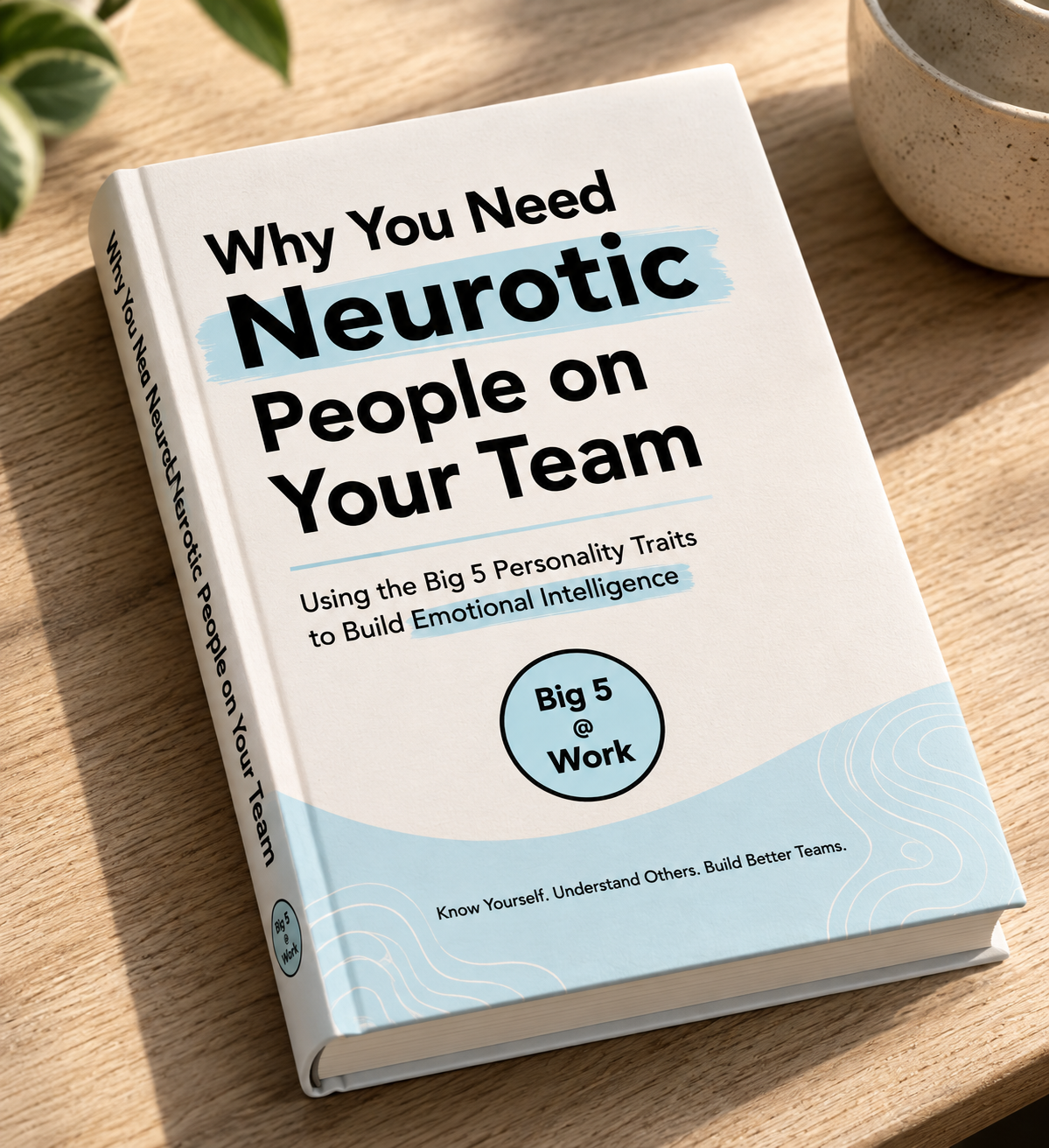
Why You Need Neurotic People on Your Team explains where personality comes from, what each of the Big Five traits really means, and how to use that knowledge to lead a team or grow your own career.
What the book is about
Most career advice tells you to adapt to the room. This book starts with a better question: how are you built, and how do you work best with people built differently?
It moves from the science, to the traits, to what you do on Monday morning.
The book is built on the Five Factor Model, the most widely studied framework in personality psychology. It covers how much of personality is inherited, how stable it stays over a career, and how much it can still change.
Every claim is checked against the research, and the book is clear about popular stories that haven’t held up.
Each trait gets its own chapter. You’ll learn what it measures, the six facets that make it up, and the superpower at both ends of the spectrum. There are no wrong answers.
The second half of the book turns what you’ve learned into practical steps, whether you manage a team or want to grow in your own role.
Includes Two Things Are True, the book’s method for hard conversations: name a fact about the other person’s reality, name a fact about the situation, then solve it together.
Make it personal
The Comprehensive Assessment gives you 29 facet scores, AI-powered analysis, and a personal report, so each chapter reads like it’s about you.

About the author
Christin is the founder and CEO of Big 5 at Work. She spent her career in marketing, most recently in clean energy, where she learned firsthand how much of a team’s success depends on the people in the room understanding each other.
It’s a Kindle eBook. You can read it on a Kindle or in the free Kindle app on a phone, tablet or computer, and it’s included with Kindle Unlimited.
We recommend it. The book stands on its own, but it means more once you know where you sit on each trait.
Neither. In the Five Factor Model, Neuroticism describes how sensitive someone is to stress and risk. It is not a clinical diagnosis.
Yes. If you’re booking a workshop, let us know you’d like to use the book as a pre-read and we’ll help plan around it.
.svg)